


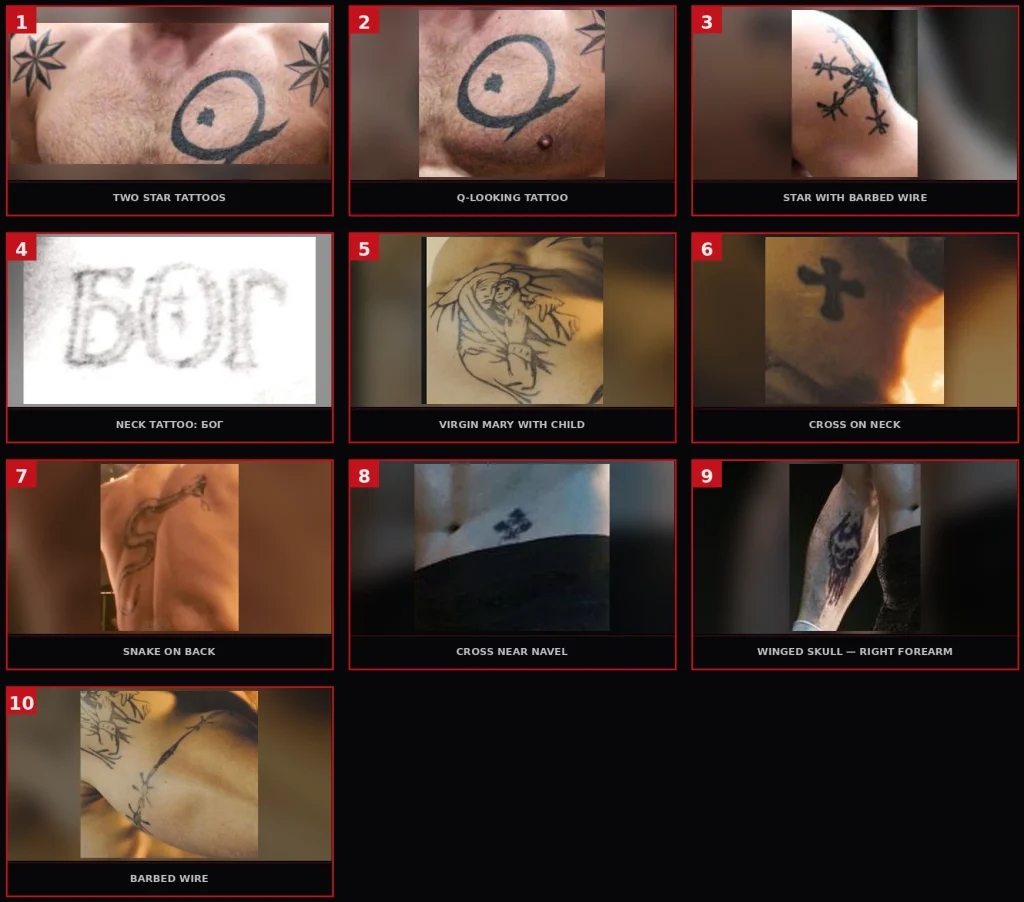
Yuri Boyka, portrayed by Scott Adkins in the Undisputed film series, is known not only for his exceptional fighting skills but also for his distinctive tattoos. Each design contributes to his intimidating appearance and reflects themes associated with his character, including faith, discipline, suffering, strength, and redemption.
From traditional Russian prison-inspired stars to Christian crosses, religious imagery, and powerful symbols such as snakes and skulls, Boyka’s tattoos create a fascinating part of his on-screen identity.
Explore the 10 tattoos featured on Boyka’s body and discover the symbolism and cultural meanings behind each design.
Yuri Boyka – the tattoos
1. Two star Tattoos
Yuri Boyka has two matching eight-pointed star tattoos on his upper chest, close to his shoulders. These striking stars are reminiscent of traditional Russian prison tattoos, where symbols can represent a prisoner’s status, authority, and reputation within the criminal underworld.
In Russian prison tattoo culture, eight-pointed stars are often associated with power and respect. Stars tattooed on the knees traditionally symbolise a refusal to submit to authority, expressing the attitude: “I will never kneel before anyone.”
The placement of Boyka’s stars near his shoulders gives them a particularly imposing appearance. They reinforce his image as a proud, disciplined fighter who refuses to bow to anyone.
2. Q-looking Tattoo
Japanese ensō, a circle associated with Zen Buddhist art.
The ensō symbolises enlightenment, simplicity, strength, and the universe. Traditionally drawn in one or two brushstrokes, it represents a moment of clarity in which the mind and body act freely and naturally.
Whether viewed as an abstract design or through its resemblance to the ensō, the tattoo adds a distinctive element to Boyka’s appearance. Its circular shape also lends itself to interpretations of balance, wholeness, and inner strength.
3. Star with barbed wire
On Yuri Boyka’s shoulder is a star that appears to be surrounded by barbed wire. The combination creates a harsh, prison-inspired design that evokes confinement, hardship, and a troubled past.
Stars have a long history in Russian prison tattoo culture, while barbed wire is widely associated with restriction, suffering, and life behind bars. Together, these elements suggest a connection to Boyka’s past and the difficult experiences that have shaped him.
The contrast between the star and the barbed wire also reflects a struggle between status and confinement, freedom and restriction. It is a fitting design for a character whose life revolves around fighting, survival, and overcoming adversity.
4. БОГ-Tattoo Neck
The tattoo on Yuri Boyka’s neck displays the Cyrillic word БОГ, which means “God” in Russian. It is a direct religious reference and stands out as one of the clearest expressions of Christian imagery among his tattoos.
The word evokes faith, devotion, and a connection to a higher power. Throughout the Undisputed films, Boyka’s character is shaped by themes of guilt, discipline, personal responsibility, and redemption.
Placed prominently on his neck, the tattoo reinforces the spiritual dimension of his character and creates a striking contrast with his violent life as a professional fighter.
5. Virgin Mary with Child
Boyka also has a tattoo depicting the Virgin Mary with the Christ Child. This traditional Christian image is often associated with maternal love, compassion, devotion, and divine protection.
In Christian art, the Virgin Mary represents purity, faith, and care, while the Christ Child symbolises hope and salvation. For Boyka, the image adds another layer to the religious symbolism of his tattoos.
Together with the crosses and the БОГ lettering, the image creates a strong religious theme. It contrasts with Boyka’s brutal fighting career and reflects the tension between physical violence and spiritual ideals that makes his character compelling.
6. Cross on Neck
Yuri Boyka has a cross tattoo on his neck, another prominent symbol of Christian faith. The cross is traditionally associated with sacrifice, redemption, forgiveness, and hope.
In the context of Boyka’s character, it represents the possibility of finding meaning beyond violence and physical strength. His journey throughout the Undisputed films involves more than becoming a better fighter; it also explores responsibility, humility, and the search for redemption.
The cross, together with his other religious tattoos, reinforces the idea that Boyka’s identity is shaped by both his physical discipline and his spiritual struggle.
7. Snake on back
The snake tattoo on Yuri Boyka’s back is a striking design with powerful symbolism. Across many cultures, snakes represent transformation, renewal, danger, and strength.
Because snakes shed their skin, they are often associated with change and rebirth. In Boyka’s case, this symbolism can be linked to his struggle to overcome his past and become a better version of himself.
Snakes are also known for their speed, precision, and ability to strike at the right moment. These qualities mirror Boyka’s fighting style: calculated, agile, dangerous, and relentless. Like a snake, he can remain controlled and observant before suddenly unleashing his power.
In religious traditions, snakes can also represent temptation and the conflict between good and evil. This duality suits Boyka’s complex character, whose life is marked by the tension between violence, faith, pride, and the desire for redemption.
8. Cross near Navel
Next to his navel, Yuri Boyka has another cross tattoo, with a design that differs from the cross on his neck.
The cross is one of the central symbols of Christianity and represents faith, sacrifice, forgiveness, and redemption. Its presence alongside Boyka’s other religious tattoos creates a consistent visual theme throughout his body art.
In the context of his character, the cross can be interpreted as a symbol of spiritual guidance and the hope of a new beginning. It reflects the idea that even someone with a troubled past can strive for change and seek a different path.
9. Winged Skull
On Yuri Boyka’s right forearm, there is a tattoo depicting a winged skull. The design combines two powerful images: the skull, associated with mortality and danger, and the wings, which can symbolise freedom, power, and transcendence.
Together, these elements create a dark and intimidating image that suits Boyka’s identity as a formidable underground fighter. The skull evokes fearlessness and an awareness of mortality, while the wings suggest strength and the desire to rise above limitations.
The tattoo complements Boyka’s relentless attitude in the ring. He is portrayed as a fighter who embraces risk, pushes beyond his limits, and refuses to be easily defeated.
10. Barbed Wire
Yuri Boyka also has a barbed-wire tattoo. This design is commonly associated with confinement, hardship, endurance, and the struggle to overcome difficult circumstances.
Barbed wire can represent the barriers that restrict a person’s freedom, while also symbolising the strength required to endure them. In relation to Boyka’s background as a prisoner and fighter, the tattoo evokes a life shaped by discipline, suffering, and survival.
The design also fits the harsher side of Boyka’s character: a man who has experienced a brutal world and learned to withstand its challenges. Alongside his religious tattoos, it creates a contrast between hardship and hope, confinement and the possibility of redemption.